


CARIBBEAN
Traditional Latin dances include Bachata, Merengue, Cumbia, and the now widely popular Salsa in Greece. These are also the dances most commonly performed in bars and clubs under the general name “Latin.” There are many other traditional Latin dances, but they are not as widely practiced outside their countries of origin.
CARIBBEAN / LATIN DANCES
Rhythm, expression, and the joy of life
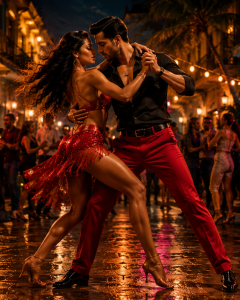
SALSA
Energy, rhythm, and social interaction in every step.
A dynamic dance full of movement, improvisation, and a strong sense of musicality.
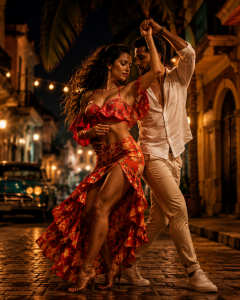
BACHATA
Romance, expression, and connection.
Sensual movement and close connection, with its distinctive rhythm.
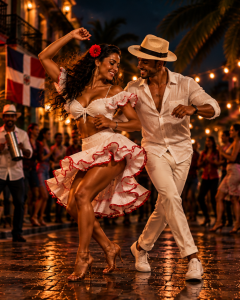
MERENGUE
Joy, liveliness, and an irresistible Caribbean rhythm.
A playful and energetic dance, perfect for letting yourself get carried away by the music.
SALSA
It is difficult to define the exact origins and roots of this dance. Salsa is a fusion of many Latin and Afro-Caribbean dances, with each region playing an important role in its development. In terms of its structure, it resembles Mambo in that both dances have a six-movement routine danced over eight measures of music. Today, the most widespread form of Salsa is danced in 4/4 time, at tempos of up to 52 bars per minute.
Salsa and Mambo share many movements and steps. In Salsa, turns have become an important characteristic, resulting in a significantly different overall look and feel from Mambo. Mambo tends to move more forwards and backwards, whereas Salsa involves more lateral movement.
Salsa varies from place to place. In New York (New York Style), for example, Salsa is danced on the second beat of the rhythm, along a linear pattern. In Los Angeles (LA Style), it is danced on the first beat, also along a linear pattern. In contrast, the Cuban style (Cuban Style) is more free-flowing across the dance floor. Other Salsa styles include Colombian or Cali Style and Miami Style. Each style has its own characteristics, and there is no comparison between them.
There is also Rueda, a group form of Salsa. Couples dance in a circle, with the basic step being the Dile Que No, occasionally joining hands and frequently switching partners.
In general, Salsa is a dance that has been heavily influenced by Spanish culture, while also incorporating influences from each region where it has evolved.
BACHATA
The word Bachata means “party.” Bachata, both as a dance and a musical genre, originates from the Dominican Republic, and its lyrics most commonly focus on the pain of separation and romance. In simple terms, it is the Latin equivalent of American Blues. The melody is usually played on an electric guitar in a sequence of eight notes. As a dance, it has become particularly popular in recent years.
Bachata is danced in 4/4 time, with four steps per cycle, the fourth being simply a toe touch rather than a full weight-bearing step. The basic movement is side-to-side, with the couple maintaining a close distance. It is generally a very sensual dance, which is why it is sometimes misunderstood.
The first recorded Bachata performance dates back to 1961, when musician José Manuel Calderón released the songs “Borracho de Amor” and “Qué Será de Mí.” The rhythm is said to have originated from Bolero music, which was regarded as a form of romantic Latin music.
MERENGUE
Merengue is a very popular musical and dance style from the Dominican Republic. It developed in the early 19th century and is closely related to Haitian Meringue. Its rhythm is a moderated version of a particularly fast duple meter and is danced with simple side-to-side two-step patterns. It was influenced by two forms of folk music that used various musical instruments, as well as by different popular orchestral performances. The most important performers and bandleaders associated with this dance are Angel Victoria, Johnny Ventura, and Juan Luis Guerra. The dance is performed in 2/4 time, at tempos ranging from 55 to 70 bars per minute. Its footwork is predominantly “ball-flat.” It has been “Americanized” since the 1950s.
The movements used today differ from those of the “Ballroom” version in that they are more stationary, without progressing along the line of dance. Both the dance and the music have a more grounded and sensual feel, using the closed position and intricate rotational movements. In Merengue, there are no steps that last for two beats of the rhythm. Today, Merengue is danced either in the Ballroom style (along a line of dance moving counterclockwise) or in the Club style, which is characterized by pronounced Cuban motion.