
ARGENTINE TANGO
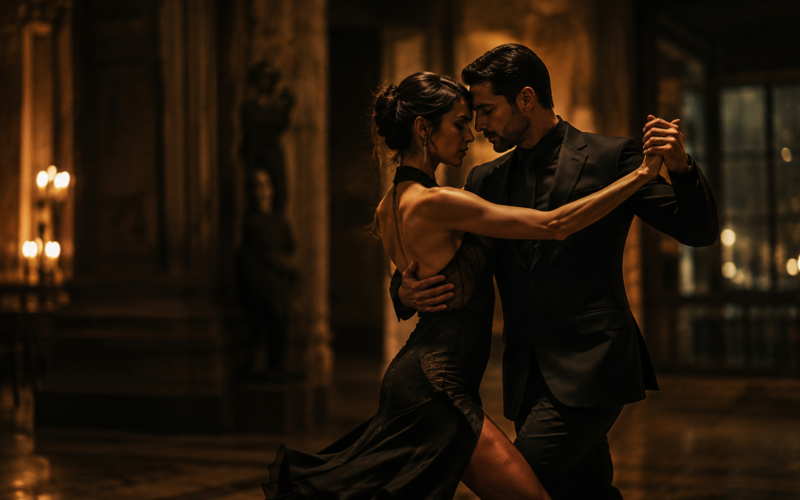
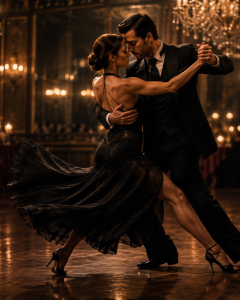
Argentine Tango is a dialogue.
It is the moment when two people communicate without words, through music, movement, and embrace.
At HotSteps, we explore different aspects of Tango culture — from the contemporary creativity of Tango Nuevo, to the theatricality of Tango Escenario, the lively rhythm of Milonga and the flow of Tango Vals.
ARGENTINE TANGO STYLES
Which Tango speaks to you?
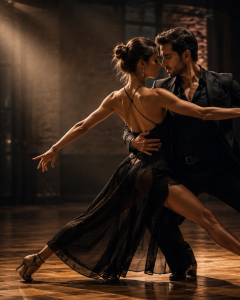
TANGO NUEVO
Evolution · Exploration · Improvisation
The contemporary side of Argentine Tango.
Explore axis, movement, balance, and improvisation, and discover new ways to create through dance.
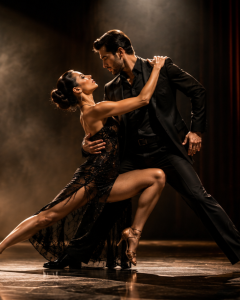
TANGO ESCENARIO
Stage · Expression · Spectacle
Tango becomes a performance.
Technique, choreography, dynamic movements, and stage presence come together to create a story that is not simply danced — it is performed.
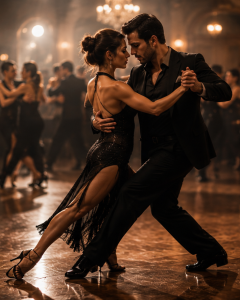
MILONGA
Rhythm · Energy · Playfulness
The most playful side of Tango.
Fast rhythm, small and precise movements, and a constant dialogue with the music.
TANGO VALS
Flow · Musicality · Connection
The Tango that flows naturally.
The music guides the movement, while the couple creates a continuous flow through walking, turns, and connection.
TANGO NUEVO
The contemporary side of Argentine Tango.
Tango Nuevo is a contemporary approach to Argentine Tango that developed particularly from the 1980s onwards, through the exploration of new ways of moving, connecting, and improvising.
It is based on an understanding of the body, axis, balance, and the relationship between the two dancers. Movement becomes an object of exploration rather than simply the reproduction of predetermined figures.
In Tango Nuevo, we encounter changes in the distance between the dancers, shifts in axis, dynamic rotations, new movement concepts, and greater freedom in improvisation.
The student learns to understand how movement is created, so that they can gradually create their own.
Tango Nuevo is for those who want to move beyond memorizing steps and discover Tango as an ongoing space for creativity.
Because Nuevo doesn’t just teach you more figures.
It teaches you to think about movement differently.
TANGO ESCENARIO
When Tango becomes a stage art.
Tango Escenario, also known as Stage Tango, is the theatrical form of Argentine Tango. Here, the dance is not created solely for the connection between two people on the floor of a milonga, but to be performed in front of an audience.
The stage allows for greater freedom in movement and choreography. Long lines, dynamic rotations, spectacular figures, changes of level, jumps, and a strong stage presence can be combined with the distinctive aesthetics of Tango.
Training requires technical precision, physical strength, flexibility, coordination, musicality, and complete trust between the two dancers.
At the same time, the dancer learns to use their body and expression to tell a story and connect with the audience.
At our school, Tango Escenario is approached as a complete performing art: technique, choreography, interpretation, and stage presence come together to create a result that is not simply danced — it is performed.
Because on stage, dancing alone is not enough.
You need to have something to say.
MILONGA
The rhythm, playfulness, and joy of Tango.
Milonga is one of the fundamental elements of Río de la Plata culture and is directly connected to the history and evolution of Argentine Tango.
As a dance form, it is characterized by a livelier rhythmic feel and a different quality of movement than Tango. The movement is generally faster, more compact, and playful, requiring precision, quick reactions, and a strong sense of rhythm.
Milonga teaches the dancer to truly listen to the music and respond instantly to its changes. Movements do not need to be large to be expressive; instead, economy and precision of movement are an important part of its charm.
Through Milonga, the student develops rhythm, coordination, quick reactions, and improvisation.
And above all, they discover a different side of Tango:
lighter, more playful, and full of life.
TANGO VALS
When Tango is allowed to flow.
Tango Vals is a distinct form within the Argentine Tango tradition, danced to music in triple meter and creating a unique sense of continuous flow.
Compared to classic Tango, the movement becomes more fluid and continuous. The couple seems to travel through the music, with walking, turns, and changes of direction flowing together into an uninterrupted movement.
The main challenge for the dancer is to feel the pulse and not treat the music as merely a way of counting steps. Weight transfer, balance, connection, and the quality of the walk become essential tools.
Tango Vals particularly develops musicality and the couple’s ability to move with naturalness and continuity.
It is a dance that does not rely on the complexity of the figures, but on flow, communication, and a connection to the music.
Because in Tango Vals, you don’t simply count the rhythm.
You let yourself be carried away.