

LATIN DANCE
From the sensual Rumba to the explosive Jive, Latin dances combine dynamic movement, musicality, and a unique character.
RHYTHM, MOVEMENT AND ENERGY
Many widely popular dances around the world originate from Latin America. Some examples include Merengue, Rueda, Salsa, Mambo, and more. Some of these, such as Samba, Cha Cha Cha, Rhumba, Jive, and Paso Doble, have stood out and have therefore been incorporated into Latin competitive dance (International Dance Sport Competitions). These are partner dances that continue to evolve over time, incorporating new acrobatic elements, more precise techniques, and an ever-growing range of figures.
The holds used in these dances vary from figure to figure and can range from a closed hold with a frame to an open one-hand hold or completely free movement. The figures in these dances have now been documented and categorized according to their level of difficulty in both execution and learning. Since the beginning of the 20th century, when Latin American dances began to spread across Western Europe, internationally agreed-upon terminology, techniques, rhythms, and figures have been established to ensure greater consistency and proper organization in both competitive and social dancing.
Rumba
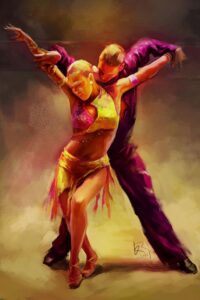 Rumba originated in Havana, Cuba, during the 1890s–1900s. It is said that, in its early days, Rumba was danced mainly among the Afro-Cuban community rather than the local population, as it was considered a dangerous and provocative dance.
Its music is played in 4/4 time and originated from a blend of rhythms rooted in the West Indies and Africa. The development of the rhythm, along with its accompanying dance, took place in Cuba in the form of **Son** (a slower version of the rhythm that became popular among Havana’s middle class) or **Danzón**, which was danced among members of Cuba’s upper class. The melodies are influenced by Spanish musical traditions of the time.
Today, Rumba is characterized as the dance of love and passion.
The first appearance of Rumba in dance competitions with an official syllabus dates back to 1931, under the name “Square Rumba,” the same year that Pierre Zurcher-Margolle introduced Latin dances to Europe (England). Following the official recognition of the dance, Walter Laird’s first book was published, which included a detailed description of the first official Rumba syllabus, as well as an analysis of the dance technique.
The technique of Rumba incorporates sharp movements and a combination of the gentleman’s romantic advances toward the lady, who maintains a defensive stance toward him. In the American style of the dance, there is a pronounced hip sway, initiated by slightly bent knees, in contrast to the International style, in which the legs should remain straight.
Rumba has also contributed greatly to other dances, such as Cha Cha Cha. In fact, most, if not all, of the figures from Rumba can be adapted and performed in Cha Cha Cha as well.
Rumba first appeared as a dance in Havana, Cuba, in the late 19th century.ου It is said that, originally, Rumba was danced among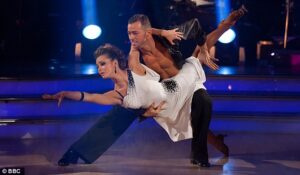 among the Afro-Cubans living in the area, namely African slaves who had been brought to Cuba to work on plantations. The dance is characterized by pronounced hip movements, which are said to have originated from the effort made by slaves to carry heavy loads on their backs, using significant force and movement in the lower body, particularly the legs and hips, while keeping their backs steady. The swaying of the hips, combined with the physical contact between the partners, led locals during this early period of Rumba to consider it a provocative, obscene, and dangerous dance.
In the middle of the 20th century.ου dancer Pierre Zurcher-Margolle visited Cuba to study the dances of the island, and this is how Rumba made its way to Europe, where its “propriety” initially sparked controversy. Following the official recognition of the dance, Walter Laird’s first book was published, containing a detailed syllabus of Rumba figures, as well as an analysis of the dance technique.
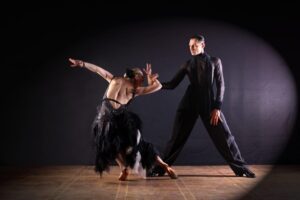 The technique of Rumba incorporates sharp movements and serves as a sensual representation of the couple, with a strong element of eroticism, where the gentleman pursues and the lady responds defensively. In the American style of the dance (hip sway), pronounced hip movement originates from the dancers’ slightly bent knees, whereas in the International style, the legs are kept straight. The music is played in 4/4 time. Rumba has also contributed greatly to other dances, such as Cha Cha Cha, as many of its figures can be adapted to its rhythm.
Cha Cha Cha
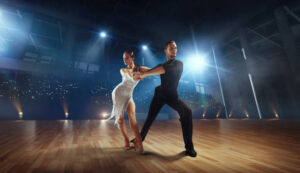
Couple dancers perform latin dance on large professional stage. Ballroom dancing.
Cha Cha Cha was born in Havana, created by the great Cuban musician, charismatic violinist, and composer Enrique Jorrín (1926–1987). The first song performed in the Cha Cha Cha rhythm was “La Engañadora,” which also gave its name to the album of the same title, recorded in 1953. It is said that Enrique Jorrín was inspired to name the dance Cha Cha Cha after the sound made by the dancers’ shoes.
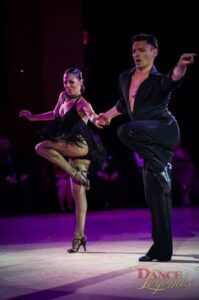
In 1954, the Enrique Jorrín Orchestra was formed, and from 1955 onwards, it toured Mexico, Panama, Venezuela, the United States, as well as…
Europe and Africa. Over the years, the creator of Cha Cha Cha added the sounds of the trumpet, bass, and other instruments. Cha Cha Cha quickly became popular and established itself as a signature rhythm of Cuban music. Its technique is characterized by pronounced hip movement, sharp movements, quick weight changes, and, above all, the “chassé,” which consists of three quick steps between the beats of the rhythm.
There are several similarities between the techniques of Cha Cha Cha and Rumba. The main differences are primarily due to the faster tempo of Cha Cha Cha.
Mambo
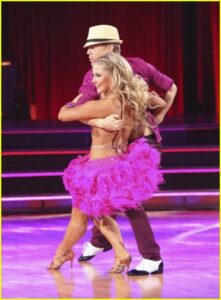
Mambo first appeared in Cuba. It is said that it was initially danced among Haitian settlers and that it took its name from “Mambo,” the female priestess of Haiti who participated in voodoo ceremonies.
The Cuban pianist, composer, and arranger Pérez Prado (1916–1989), together with his band, was instrumental in popularizing Mambo in the mid-20th century, particularly with his major hit “Mambo No. 5” (1949). This worldwide success, along with those that followed, earned Pérez Prado the nickname “King of Mambo.” Since then, many musicians, including Tito Rodríguez, Pupi Campo, Tito Puente, Machito, and Xavier Cugat, have developed their own styles and techniques, helping to evolve and promote Mambo to the prominent position it holds today.
It is a fast and lively dance, with a 4/4 rhythm. Turns, pronounced hip movements, and speed are some of the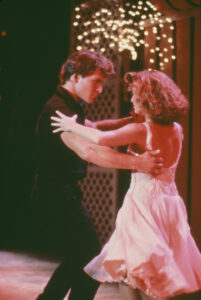 characteristics that made it popular among dancers. It is worth noting that Mambo contributed greatly to the development of Cha Cha Cha.
In America, Mambo first appeared in 1947 at the Park Plaza Ballroom in New York, one of the favorite gathering places for enthusiastic dancers from Harlem. Later, a simplified version of the dance was introduced in dance schools and clubs in New York and Miami, as the original dance featured highly dangerous acrobatic figures.
As a dance, Mambo initially generated a great deal of interest, but its development later remained relatively stagnant. However, it is important to note that it contributed significantly to the creation of Cha Cha Cha.
Samba
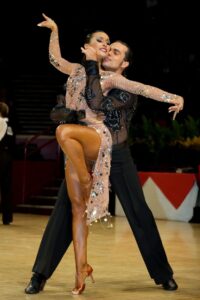 One could say that Samba and Brazil (I would also add football) are practically synonymous, and indeed they are. December 2nd is National Samba Day, and by official UNESCO decision, Samba has been recognized as part of Brazil’s intangible cultural heritage. It is the quintessential music accompanying Carnival in Brazil. In the 16th century, the Portuguese brought African slaves from Angola and the Congo to Brazil, and it was among these communities that Samba first emerged to the sound of percussion instruments.
However, Samba also incorporates influences and is a blend of African and Portuguese sounds and rhythms, as well as those of Brazil’s indigenous peoples, such as Lundu. Over time, Samba has been known by various names, including Zemba 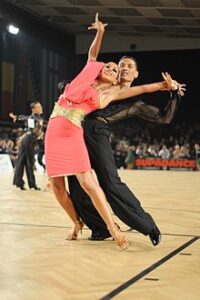
Cueca, Mesemba, and Maxixe. In the 1920s, Samba became particularly popular in France, and in 1928, Paul Boucher included instructions for dancing Samba in his book. In 1939, Samba made its way to the United States, where Ary Barroso composed “Brasil,” which received such widespread acclaim and success that the musical *Brasil* was produced in Hollywood in 1944.
Samba is a fast, joyful, and energetic dance. It is characterized by numerous turns, pronounced movement of the hips and pelvis, and strong, rapid bending of the knees (bounce action). It is danced to a 2/4 rhythm.
Jive
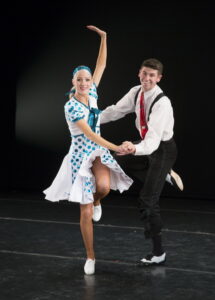
Jive is the fastest of the Latin dances. It first appeared in the late 19th century in Central and South America, and during the 20th century it emerged in African-American neighborhoods in New York and other cities. It was preceded by dances such as Lindy Hop (1930s), Blue Swing and Boogie-Woogie (from the 1940s), Jitterbug, and Rock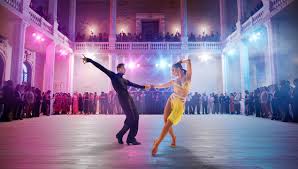 ‘n’ Roll (from the 1950s). Major musicians performed Jive songs, with the most popular being Elvis Presley, Jerry Lee Lewis, and Little Richard.
Jive is characterized by a fast 4/4 or 2/4 rhythm, rapid footwork, and continuous movement. Strong, dynamic movements, numerous turns, and a wide variety of figures highlight the beauty of this dance.
Paso Doble
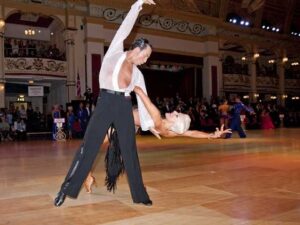 Paso Doble (“two steps”) is a particularly dynamic dance that creates an intense atmosphere. Its origins can be traced to southern France in the first half of the 20th century. Its main characteristic is the imitation of the movements
of the dancers to those of Spanish bullfighters. The music of Paso Doble is inspired by the music played during the bullfighter’s entrance into the arena (paseo), as well as the movements he makes until the end of the bullfight. During the dance, the gentleman “plays” the role of the bullfighter (matador), while the lady either follows as the matador’s “shadow,” taking on the role of his cape, or portrays the bull, or performs figures derived from Flamenco.
Ballroom Paso Doble, like Samba, is a progressive International Latin dance.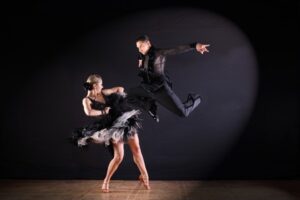 which most closely resembles the International Standard style. The dancers’ forward steps are taken with the heel, while the frame is wider and more rigid, with less hip movement. It shares several elements with Flamenco, one of Spain’s most well-known traditional dances, and its rhythm is 2/4. It is worth noting that Paso Doble is the only one of the five dances in International Latin competitions in which the gentleman has a more prominent role than the lady.